



A severe shoulder injury requiring surgery can rob you of your ability to work, care for your family, and perform everyday tasks you once took for granted. The recovery process is long, painful, and expensive, leaving many victims struggling with mounting medical bills while unable to earn an income.
At Ganim Legal, P.C., our Bridgeport personal injury lawyer understands the devastating impact these injuries have on your life and your family’s financial security.
Without experienced legal representation, insurance companies will pressure you to settle early—often before you understand the full extent of your recovery needs. They may minimize the severity of your injury or claim your shoulder problems existed before the accident.
Meanwhile, you face months of physical therapy, potential complications, and the risk that you’ll never regain full function of your shoulder.
Our firm provides the solution. We fight to recover every dollar you deserve for surgery costs, rehabilitation, lost wages, and the permanent limitations that may affect you for the rest of your life.
Go With Who You Know. Call Park Avenue Paul at 203-884-7075 or contact us online to discuss your shoulder surgery case with an experienced Bridgeport shoulder surgery lawyer.
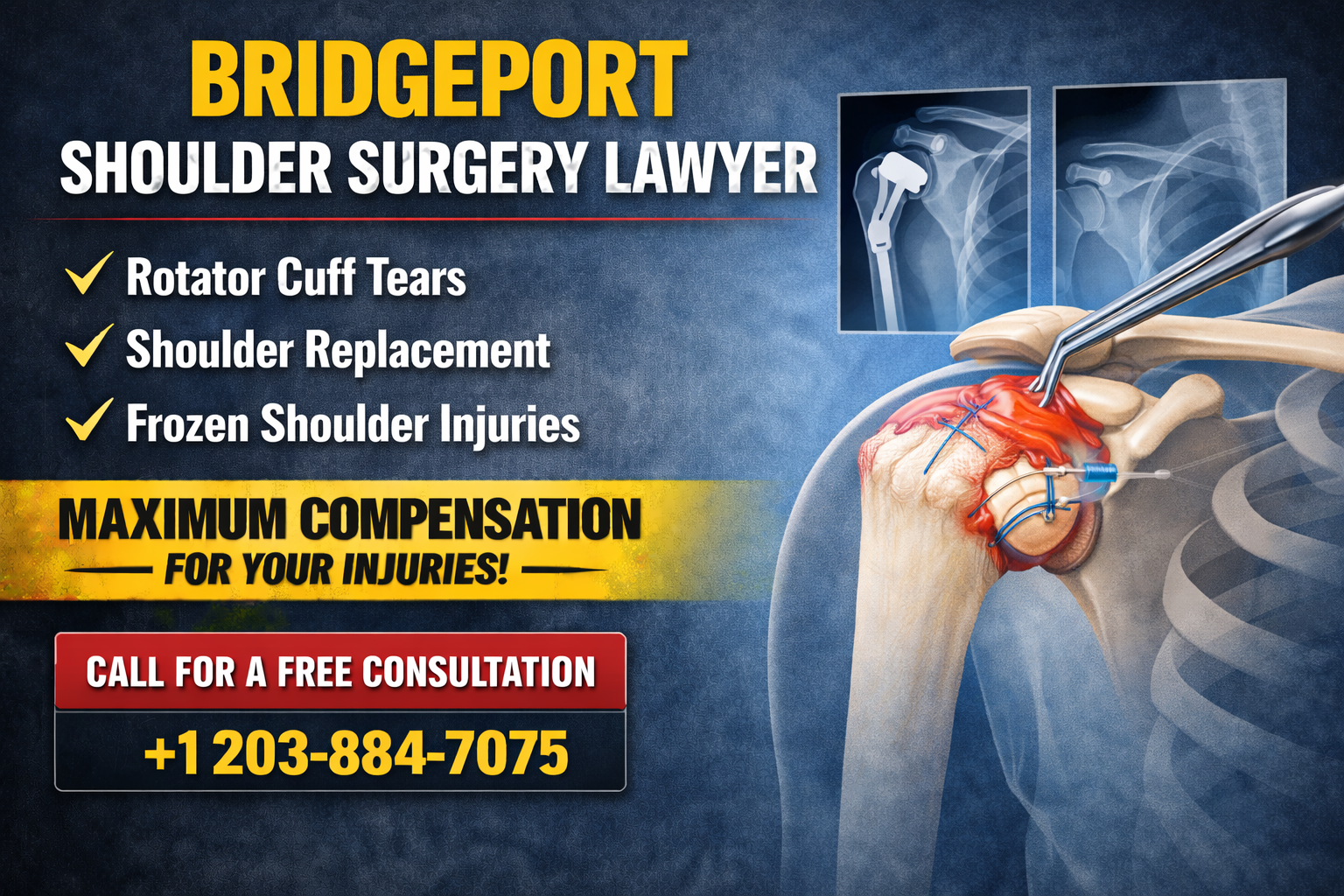
Do You Have Grounds For a Shoulder Surgery Claim?
To pursue compensation for a shoulder injury requiring surgery, our team must establish four essential legal elements:
- Duty of care: The responsible party owed you a legal obligation to act reasonably and avoid causing harm. This duty applies to drivers on the road, employers at worksites, property owners maintaining safe premises, and medical providers delivering appropriate care.
- Breach of duty: The at-fault party violated that duty through negligent actions or failures. Examples include unsafe property conditions, reckless driving, medical errors during treatment, or failure to diagnose a serious condition that worsened your shoulder injury.
- Causation: The negligent conduct directly caused the trauma that led to your need for shoulder surgery. We must prove a clear link between the defendant’s actions and your injury, showing that the accident or incident necessitated surgical intervention.
- Damages: You suffered measurable losses, including surgery costs, rehabilitation expenses, lost income, and permanent functional limitations. These damages must be documented through medical records, bills, employment records, and expert testimony about your prognosis.
Damages You Can Recover
Connecticut law allows shoulder surgery injury victims to pursue multiple categories of compensation:
- Economic damages: These cover all measurable financial losses, including past and future medical expenses for surgery, diagnostic imaging, hospital stays, prescription medications, physical therapy sessions, and any additional procedures needed. Lost wages from time away from work and reduced earning capacity if you cannot return to your previous occupation also fall under economic damages.
- Non-economic damages: Connecticut compensates victims for intangible losses such as physical pain and suffering, loss of shoulder mobility and function, chronic discomfort, emotional distress from limitations, reduced quality of life, and inability to participate in activities you once enjoyed. Connecticut does not cap non-economic damages in personal injury cases, allowing full recovery based on the actual impact of your injuries.
- Punitive damages: In limited cases involving extreme recklessness or intentional misconduct, Connecticut law may allow punitive damages. These damages are uncommon and are typically tied to the plaintiff’s litigation costs and attorneys’ fees rather than large punitive awards. They may apply when the at-fault party acted with willful or wanton disregard for your safety.
How Much Compensation Can You Expect?
Settlement values vary significantly based on injury severity, surgical complexity, and long-term prognosis. The following ranges represent typical compensation amounts:
| Shoulder Injury / Surgery | Typical Compensation Range |
|---|---|
| Non-surgical shoulder tear | $15,000 – $40,000 |
| Rotator cuff surgery | $50,000 – $150,000 |
| Labral repair surgery | $40,000 – $120,000 |
| Fracture requiring surgery | $75,000 – $200,000 |
| Permanent loss of shoulder function | $150,000 – $500,000+ |
Despite these averages, our firm has secured settlements and verdicts that significantly exceed typical ranges. Consider these actual case results:
- $900,000.00: The Plaintiff, a 43-year-old man, was awarded $900,000.00 in a products liability suit after losing two fingers in a wood chipper accident. The Plaintiff was feeding branches into the wood chipper when the glove on his right hand became entangled in a branch. His hand was pulled into the blades, resulting in serious injuries.
- $590,000: The Plaintiff, a 38-year-old man, reached a $590,000 settlement with his employer after suffering serious injuries in a work-related accident. The Plaintiff was working on a garbage truck when the driver struck a utility pole, crushing the Plaintiff’s arm. The Plaintiff sustained serious injuries to his arm and could not work as a result.
- $283,544.00: The Plaintiff, a 40-year-old man, was awarded $283,544.00 plus interest after being rear-ended while stopped at a red light on East Main Street in Stamford. The Defendant failed to keep a proper lookout and was traveling at an unreasonable speed at the time of the accident. The Plaintiff suffered from serious neck and back injuries as a result.
💡 Want to estimate the potential value of your shoulder surgery case? Our shoulder surgery settlement calculator provides a personalized estimate based on your injury details, surgery type, and recovery timeline. Simply enter your information to receive an immediate assessment of what your claim may be worth.
Disclaimer: The results generated by settlement calculators are for informational and illustrative purposes only. They do not constitute legal advice or a substitute for professional evaluation of your specific case. Past results do not guarantee future outcomes.
How to Get in Touch With Our Bridgeport Shoulder Surgery Lawyer
We make it easy to discuss your case with an experienced attorney:
- Telephone: Call 203-884-7075 to speak directly with our legal team
- Online contact form: Visit our contact page to submit your case details
- Free consultation: We offer complimentary case evaluations with no obligation—learn your legal options at no cost
Go With Who You Know. Call Park Avenue Paul for your free consultation about pursuing compensation for your shoulder surgery injury.
Common Shoulder Injuries That Require Surgery
We represent clients with all types of shoulder injuries that necessitate surgical intervention. Our Bridgeport shoulder surgery lawyer has particular experience handling cases involving:
- Fractured clavicle or humerus requiring surgical repair
- Labral tears (SLAP tears) necessitating arthroscopic surgery
- Nerve damage affecting shoulder function and mobility
- Post-traumatic arthritis requiring joint replacement
- Rotator cuff tears requiring surgical reconstruction
- Shoulder dislocations with ligament damage
How Our Bridgeport Shoulder Surgery Law Firm Can Help
Our comprehensive legal services address every aspect of your shoulder surgery injury claim:
- Medical bill recovery: We pursue full compensation for all surgical costs, hospital stays, anesthesia, medications, and post-operative care
- Lost wages compensation: We document your time away from work and fight for payment of all income you’ve lost during recovery
- Proving medical necessity: We work with orthopedic experts to demonstrate that surgery was required due to the defendant’s negligence
- Orthopedic documentation: We obtain and analyze surgical reports, operative notes, imaging studies, and physician opinions supporting your claim
- Permanent impairment assessment: We retain medical experts to evaluate lasting limitations and calculate the impact on your earning capacity
- Future care planning: We project ongoing treatment needs, including physical therapy, pain management, and potential revision surgeries
- Insurance negotiation: We handle all communications with insurance adjusters who attempt to minimize your claim or argue pre-existing conditions
- Work limitation documentation: We secure vocational expert testimony about restrictions that prevent you from returning to your previous occupation
Myth vs Facts Relating to Your Claim
Many misconceptions exist about shoulder surgery injury claims. Understanding the truth protects your legal rights:
| Myth | Fact |
|---|---|
| “Full recovery from shoulder surgery is guaranteed.” | Many patients experience permanent limitations even after successful surgery. Compensation accounts for ongoing restrictions and reduced function. |
| “Insurance automatically pays for injury-related surgeries.” | Insurance companies routinely dispute medical necessity and claim surgeries were elective or unrelated to the accident. Legal representation is essential. |
| “Prior shoulder problems eliminate your claim.” | Connecticut law allows recovery even with pre-existing conditions. You can still pursue compensation if the accident aggravated or worsened your shoulder injury. |
| “You must accept the first settlement offer.” | Initial offers rarely reflect the full value of shoulder surgery cases. Most settlements increase significantly with experienced legal representation. |
| “Filing a lawsuit means going to trial.” | The majority of shoulder surgery cases settle before trial. However, preparing for trial motivates insurance companies to offer fair compensation. |
Your First Actions After a Bridgeport Shoulder Surgery Injury
Taking the right steps immediately after your injury significantly strengthens your legal claim:
- Contact our shoulder injury lawyer early: Consulting an attorney before giving statements to insurance companies protects your rights and prevents common mistakes that damage claims. Early legal involvement allows us to preserve critical evidence while memories remain fresh and helps you avoid missing important filing deadlines.
- Follow medical advice and therapy strictly: Attending all appointments and completing prescribed physical therapy demonstrates commitment to recovery and prevents insurance companies from claiming you didn’t take reasonable steps to heal. Gaps in treatment give defendants ammunition to argue your injuries weren’t serious.
- Avoid recorded statements about recovery: Insurance adjusters may contact you seeking recorded statements or social media posts suggesting you’re feeling better. Premature optimism about recovery can be used against you later when complications arise or limitations become permanent.
- Do not downplay pain or limitations: Many injury victims minimize symptoms during medical appointments or conversations with insurance adjusters out of politeness or optimism. Always accurately report all symptoms, functional difficulties, and pain levels to ensure proper documentation.
- Document functional loss thoroughly: Keep a journal noting specific tasks you can no longer perform at work, difficulty sleeping due to shoulder pain, inability to lift your children or grandchildren, and challenges with personal care activities. This documentation proves the real-world impact of your injury.
- Preserve all evidence related to your accident: Save clothing worn during the incident, photograph the accident scene and your injuries, collect contact information for witnesses, and obtain incident reports from police or property owners. Physical evidence may be lost or destroyed if not secured promptly.
- Avoid discussing your case publicly: Do not post about your accident or recovery on social media platforms where insurance companies can access your content. Defense attorneys routinely review Facebook, Instagram, and other social media to find posts contradicting injury claims.
Don’t navigate the complex legal process alone—contact Ganim Legal, P.C. today to protect your rights and maximize your shoulder surgery injury compensation.
Insurance Company Tactics to Be Aware Of
Based on our extensive experience handling shoulder surgery cases, we’ve identified common strategies insurance companies use to minimize compensation. Working with insurance adjusters on your own leaves you vulnerable to these tactics, while our expertise allows us to counter their approaches effectively.
Insurance companies employ these strategies to reduce payouts:
- Claiming surgery was unnecessary: Adjusters frequently argue that conservative treatment like physical therapy should have been tried longer before resorting to surgery. They may hire medical experts to suggest that less invasive alternatives were available, ignoring your surgeon’s recommendation that surgery was medically necessary given the severity of your injury.
- Arguing the injury was pre-existing: Insurance companies search for any prior shoulder complaints, past injuries, or degenerative changes on imaging studies to claim your current condition existed before the accident. They’ll suggest the incident didn’t cause your need for surgery, even when it clearly aggravated or worsened a previous condition.
- Using surveillance during rehabilitation: Defense lawyers often hire investigators to videotape you during daily activities, hoping to capture footage that appears inconsistent with your claimed limitations. They may film you performing tasks that seem to contradict statements about your functional restrictions.
- Pressuring early settlement before full recovery: Adjusters push for quick settlements while you’re overwhelmed by medical bills and lost wages, offering inadequate amounts before you understand whether you’ll need additional surgeries or face permanent limitations. These early offers rarely account for long-term consequences.
- Delaying claim processing to create financial pressure: Insurance companies intentionally slow their investigation and settlement negotiations, knowing that mounting bills create desperation that leads victims to accept lowball offers. They count on your financial stress forcing a premature settlement.
- Requesting unnecessary medical authorizations: Adjusters ask you to sign broad medical releases allowing them to request all medical records from your entire life, searching for anything they can use to devalue your claim or argue pre-existing conditions.
What if the Insurance Claims that the Injury Was Pre-Existing?
Connecticut law protects your rights even when prior shoulder issues existed. We defeat pre-existing condition arguments through:
- Aggravation of pre-existing injuries: Connecticut follows the “eggshell plaintiff” doctrine—defendants take victims as they find them. Even if you had prior shoulder problems, the at-fault party remains liable for aggravating or worsening your condition. You can recover damages for the additional harm caused by the accident.
- Medical imaging comparisons: We obtain MRI and X-ray studies from before and after the accident, demonstrating clear differences in shoulder structure and severity. Comparing these images proves the incident caused new damage requiring surgical intervention.
- Surgeon’s opinions: Your treating orthopedic surgeon’s testimony carries significant weight. We work with your doctors to obtain detailed opinions explaining how the accident caused or substantially worsened your shoulder injury, necessitating surgery that wouldn’t have been needed without the incident.
- Why prior pain doesn’t bar recovery: Connecticut courts recognize that most adults have some degree of age-related degeneration. The key question is whether the accident transformed a manageable condition into one requiring surgery. Previous minor shoulder discomfort doesn’t prevent recovery when negligence causes severe injury.
Your Deadline For Filing a Claim
Connecticut’s statute of limitations gives you two years from the date of your injury to file a lawsuit. This deadline is strict—missing it eliminates your right to pursue compensation regardless of your injury’s severity or the strength of your case.
⚠️ Many shoulder injury victims make the critical mistake of assuming that time spent recovering from surgery extends their filing deadline. It doesn’t. The clock begins running on your injury date, not when you complete rehabilitation or discover the full extent of permanent limitations.
Early legal consultation protects your leverage in negotiations. Insurance companies become less willing to offer fair settlements as your filing deadline approaches because they know you’re running out of time.
Consulting our Bridgeport shoulder surgery lawyer immediately after your accident ensures adequate time to investigate your case, gather evidence, and negotiate from a position of strength.
Gathering Evidence
Building a strong shoulder surgery case requires comprehensive documentation. Essential evidence includes:
- Surgical reports and operative notes: Detailed descriptions of the procedure performed, findings during surgery, and post-operative instructions
- Diagnostic imaging: MRI scans, X-rays, and CT scans showing the extent of shoulder damage before and after surgery
- Physical therapy records: Documentation of your rehabilitation progress, functional limitations, and therapist observations about your effort and prognosis
- Orthopedic opinions: Written reports from your treating surgeons explaining medical necessity, causation, and expected long-term outcomes
- Employer documentation: Letters confirming work restrictions, modified duty assignments, or inability to perform essential job functions
- Wage loss verification: Pay stubs, tax returns, and employer statements proving income lost due to your injury
- Before and after comparisons: Photographs or videos showing activities you could perform before the accident, but can no longer do
- Witness statements: Accounts from family members, coworkers, or friends describing how your shoulder injury has affected your daily life
📌 We understand that gathering this evidence feels overwhelming when you’re dealing with surgical recovery, pain management, and financial stress. Contact us to take this burden off your shoulders. We handle all evidence collection, allowing you to focus entirely on healing while our legal team does the hard work of building your case.
What Evidence Matters the Most?
While all documentation strengthens your claim, certain evidence carries particular weight:
- Operative notes: The surgeon’s detailed description of what they found during surgery and the procedures performed provides irrefutable proof of injury severity. These notes document the specific damage that made surgery necessary and often reference the mechanism of injury.
- Surgeon correspondence: Letters from your orthopedic surgeon to insurance companies or disability carriers explaining that your shoulder injury resulted from the accident and that surgery was medically necessary carry significant credibility. Courts give substantial weight to treating physicians’ opinions.
- Physical therapy regimens: Detailed therapy notes showing your commitment to rehabilitation, progress toward functional goals, and remaining limitations help demonstrate the injury’s impact. These records also prove you took reasonable steps to mitigate damages through prescribed treatment.
What Can I Expect to Pay?
At Ganim Legal, P.C., we handle shoulder surgery cases on a contingency fee basis. This means you pay no attorney fees unless we recover compensation for you. We receive a percentage of your final settlement or verdict, aligning our interests with yours—we only succeed financially when you do.
This arrangement eliminates financial barriers to quality legal representation. You don’t need money upfront to hire an experienced Bridgeport shoulder surgery lawyer. We advance all case costs, including expert witness fees, court filing expenses, and medical record expenses, only recovering these if we win your case.
Who Pays For Your Medical Bills While Your Case is Pending?
This practical concern weighs heavily on shoulder surgery victims facing tens of thousands in medical expenses. Several options may be available:
- Health insurance coverage: Your private health insurance typically covers injury-related medical care, though it may place a lien on your settlement to recover what it paid. We negotiate with health insurers to reduce these liens, maximizing your net recovery.
- Medical Payments coverage: If your injury occurred in a car accident, your auto insurance policy’s MedPay coverage pays medical bills up to policy limits regardless of fault. This coverage provides immediate payment without liens, though Connecticut doesn’t require insurers to offer MedPay.
- Provider lien arrangements: Some orthopedic surgeons and hospitals agree to treat personal injury patients with payment deferred until case resolution. They file liens against your eventual settlement, allowing you to receive necessary surgery without upfront payment.
- Workers’ compensation: If your shoulder injury occurred at work, Connecticut’s workers’ compensation system pays for all medical treatment related to your injury. These benefits don’t require proving employer fault.
Our Process For Handling Your Case
When you hire Ganim Legal, P.C., you can expect a thorough, strategic approach to your shoulder surgery claim:
- Free consultation and case evaluation: We meet with you to discuss your accident, review available evidence, and provide an honest assessment of your claim’s value and likelihood of success. This consultation costs nothing and creates no obligation.
- Comprehensive investigation: Our team gathers all medical records, accident reports, witness statements, and other evidence supporting your claim. We work with accident reconstruction experts, medical professionals, and vocational specialists to build the strongest possible case.
- Medical documentation and expert review: We retain board-certified orthopedic surgeons to review your treatment and provide opinions about causation, medical necessity, and prognosis. These experts evaluate whether your surgery resulted from the defendant’s negligence and what future treatment you’ll require.
- Demand presentation: Once we’ve collected all evidence, we submit a comprehensive demand package to the insurance company detailing your injuries, damages, and legal liability. This package includes medical records, expert opinions, employment documentation, and a detailed calculation of all economic and non-economic damages.
- Settlement negotiations: We engage in strategic negotiations with insurance adjusters, pushing back against lowball offers and using the strength of our evidence to secure fair compensation. Our willingness to proceed to trial motivates insurers to make reasonable settlement offers.
- Lawsuit filing if necessary: When insurance companies refuse to offer adequate settlements, we file a lawsuit and pursue your case through Connecticut’s court system. Most cases still settle after litigation begins, but we prepare every case for trial.
- Discovery and depositions: During the litigation process, both sides exchange evidence and take sworn testimony from witnesses. We depose the at-fault party, their employees, and any other relevant witnesses while defending you during your own deposition.
- Trial preparation and verdict: If your case proceeds to trial, we present compelling evidence to a jury demonstrating the defendant’s liability and the full extent of your damages. We’ve achieved significant jury verdicts for shoulder surgery injury victims throughout Connecticut.
Ready to get started? Call 203-884-7075 or contact us online to begin building your shoulder surgery injury case today.
Ganim Legal, P.C.: Your Shoulder Surgery Lawyer in Bridgeport, CT
Attorney Paul Ganim has served the Bridgeport community for over three decades, building a reputation for aggressive advocacy and exceptional results. His background as a Probate Judge provides unique insight into Connecticut’s legal system, while his courtroom experience has enabled thousands of personal injury clients to recover the compensation they deserve.
What sets Ganim Legal, P.C. apart:
- Decades of trial experience: Attorney Ganim has tried cases before juries throughout Connecticut and is admitted to practice before all state courts, including the Supreme and Appellate Courts, as well as federal courts.
- Recognition and accolades: Our firm has received numerous award,s including the CT Law Tribune Award for Personal Injury, America’s Top 100 Attorneys Lifetime Achievement Award, and membership in The National Trial Lawyers Association’s Top 100 Lawyers for multiple years.
- Personalized attention: We limit our caseload to ensure every client receives the attention their case deserves. You’ll work directly with Attorney Ganim, not a paralegal or associate.
- Community commitment: As a Bridgeport native, Attorney Ganim maintains deep connections throughout Fairfield County and understands the challenges local residents face.
Proven results: We’ve secured millions in compensation for injury victims, including the significant settlements and verdicts detailed elsewhere on this page.
General Information on Shoulder Surgeries in Bridgeport
Understanding shoulder anatomy, common surgical procedures, and typical recovery timelines helps you make informed decisions about your legal claim. This information also demonstrates why shoulder surgery cases warrant significant compensation.
Types of Shoulder Surgery
Orthopedic surgeons perform various procedures depending on the nature and severity of your injury:
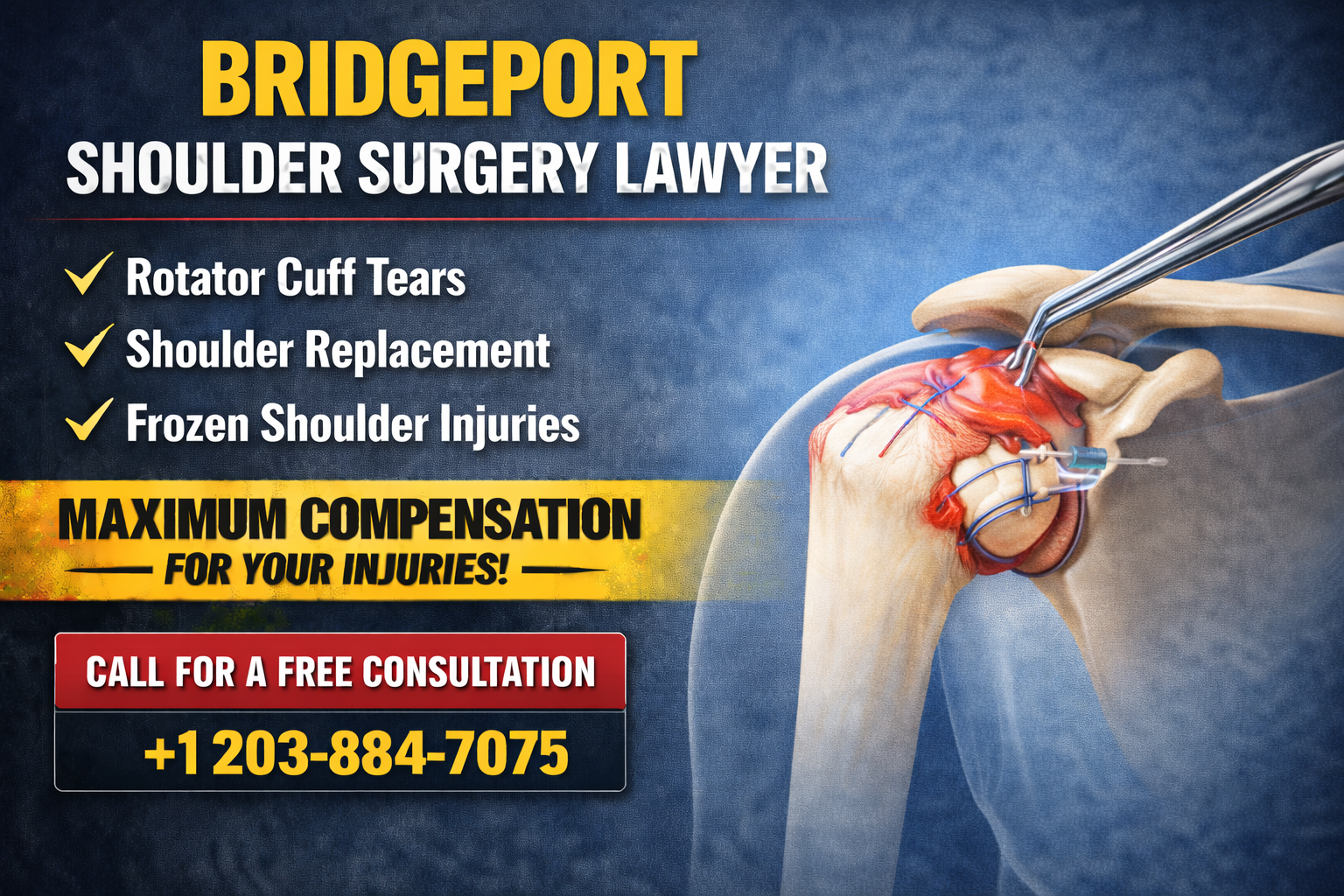
- Arthroscopic shoulder surgery: Surgeons insert a small camera and instruments through tiny incisions to repair damage with minimal disruption to surrounding tissues. This technique treats many common injuries, including rotator cuff tears and labral tears, offering shorter recovery times than open surgery but still requiring months of rehabilitation.
- Labral repair: The labrum is cartilage surrounding the shoulder socket that can tear during traumatic injuries or dislocations. SLAP (Superior Labrum Anterior to Posterior) tears typically require arthroscopic surgery to reattach torn tissue, followed by extensive physical therapy to restore stability.
- Rotator cuff repair: The rotator cuff consists of four muscles and tendons stabilizing the shoulder joint. Complete tears usually require surgical reattachment of torn tendons to the humerus bone using suture anchors, with recovery taking six months to a year.
- Shoulder replacement: Severe fractures or post-traumatic arthritis may necessitate replacing damaged joint surfaces with metal and plastic prosthetic components. Total shoulder replacement involves replacing both the ball (humeral head) and socket (glenoid), while reverse shoulder replacement reconfigures anatomy to compensate for irreparable rotator cuff damage.
- Shoulder stabilization surgery: Recurrent dislocations or severe ligament damage may require surgical reconstruction to restore joint stability. Surgeons tighten stretched ligaments and capsule tissue, often using anchors to reattach tissues to bone.
⚖️ The need for surgical intervention rather than conservative treatment like physical therapy or injections signals injury severity. Surgery becomes necessary when non-operative treatments fail to restore function or when structural damage is so severe that healing cannot occur without surgical repair.
Common Causes of Shoulder Injuries Leading to Surgery
Our Bridgeport shoulder surgery lawyer represents clients injured through various forms of negligence:
- Vehicle collisions: Car, truck, and motorcycle accidents generate tremendous force that can tear rotator cuffs, fracture shoulder bones, or cause dislocations requiring surgical repair. The Connecticut Department of Transportation reports thousands of serious injury crashes annually in Fairfield County.
- Slip and fall accidents: Falls on icy sidewalks, wet floors, or poorly maintained stairs often result in shoulder injuries as victims instinctively extend their arms to break their fall. Property owners’ failure to maintain safe premises frequently causes these preventable injuries.
- Workplace accidents: Construction workers, warehouse employees, and others performing physical labor face elevated risks of shoulder injuries from falls, struck-by incidents, or overexertion. Connecticut’s workers’ compensation system provides benefits, but third-party liability claims may also be available.
- Heavy lifting injuries: Improper lifting techniques or lifting objects that are too heavy can cause acute rotator cuff tears or shoulder strains that progress to requiring surgery. Employer negligence in training or providing adequate assistance may create liability.
- Sports trauma: Contact sports injuries during organized athletic events may give rise to claims against coaches, equipment manufacturers, or facility owners who failed to provide appropriate safety measures or proper equipment.
- Medical negligence: Surgical errors, anesthesia complications, or failure to properly diagnose shoulder injuries can worsen conditions and necessitate additional corrective surgeries. Medical malpractice claims require expert testimony demonstrating breaches of the standard of care.
Shoulder Surgery Recovery Timelines
Recovery duration varies significantly based on procedure type, injury severity, and individual healing factors:
| Surgery Type | Typical Recovery Time | Ongoing Limitations |
|---|---|---|
| Arthroscopic repair | 3–6 months | Temporary strength reduction, gradual return to overhead activities |
| Rotator cuff surgery | 6–12 months | Reduced overhead strength, potential for re-tear with heavy lifting |
| Labral repair | 4–6 months | Temporary instability concerns, gradual return to contact activities |
| Shoulder replacement | 6–12 months+ | Permanent range-of-motion limits, lifetime lifting restrictions |
| Fracture fixation | 3–6 months | Potential for post-traumatic arthritis, hardware-related complications |
Physical therapy compliance significantly impacts outcomes. Patients who diligently attend therapy sessions and perform home exercises typically achieve better results than those who miss appointments or don’t follow prescribed protocols. However, even with perfect compliance, some patients experience delayed healing, incomplete recovery, or persistent limitations.
The risk of re-injury remains elevated during recovery and sometimes permanently. Returning too quickly to work or activities before achieving sufficient strength can cause re-tears or hardware failure, necessitating revision surgery with less favorable outcomes.
How Shoulder Injuries Affect Your Body
The shoulder’s complexity and importance to daily function mean injuries cause widespread impacts:
- Pain and discomfort: Shoulder injuries typically cause severe pain that worsens with movement, disrupts sleep, and requires narcotic pain medications that affect your ability to work or drive safely.
- Loss of range of motion: Inability to reach overhead, behind your back, or across your body eliminates your capacity to perform job duties, household tasks, and personal care activities like dressing or bathing.
- Weakness and instability: Rotator cuff damage and ligament injuries cause weakness that prevents lifting, carrying, pushing, or pulling. You may feel the shoulder “giving out” during ordinary activities.
- Functional limitations: Inability to lift children or grandchildren, participate in recreational activities, perform job duties, or complete household chores dramatically reduces quality of life.
- Psychological impact: Chronic pain, permanent limitations, and loss of independence often lead to depression, anxiety, and reduced enjoyment of life that warrants compensation beyond physical damages.
When Surgery is Typically Recommended
Orthopedic surgeons evaluate multiple factors when determining whether shoulder surgery is medically necessary:
- Severity of structural damage: Complete rotator cuff tears, displaced fractures, and severe labral tears typically require surgical repair because these injuries cannot heal properly without surgical intervention to restore normal anatomy.
- Failure of conservative treatment: Surgeons usually recommend attempting physical therapy, anti-inflammatory medications, and cortisone injections before proceeding to surgery. When these conservative measures fail to restore adequate function after several months, surgery becomes necessary.
- Patient age and activity level: Younger, more active patients typically benefit more from surgical repair than elderly patients with low activity demands. However, even older patients may need surgery when injuries prevent basic daily activities.
- Occupational demands: Patients whose jobs require overhead work, lifting, or repetitive shoulder use often need surgery to return to their occupation even when they might function adequately with conservative treatment in sedentary jobs.
- Degree of functional impairment: When shoulder injuries prevent you from working, caring for yourself, or performing activities essential to your quality of life, surgery becomes necessary regardless of age or activity level.
Surgeons base recommendations on physical examination findings, imaging studies showing structural damage, and consideration of your specific functional goals. Their medical opinions about the necessity carry significant weight in personal injury claims when insurance companies question whether surgery was required.
Speak to a Bridgeport Shoulder Surgery Attorney Today!
If you’ve undergone shoulder surgery after someone else’s negligence caused your injury, you deserve full compensation for your medical expenses, lost wages, pain, and permanent limitations. Don’t let insurance companies minimize your claim or pressure you into accepting inadequate settlements.
⚖️ At Ganim Legal, P.C., we’ve spent over 30 years fighting for injury victims throughout Connecticut. Our experience, resources, and commitment to personalized service help shoulder surgery injury victims secure the compensation they need to move forward with their lives.
We’ll review your case, explain your legal options, and outline the next steps for pursuing maximum compensation. Our contingency fee arrangement means you risk nothing—you pay no attorney fees unless we win your case.
Go With Who You Know. Call Park Avenue Paul at 203-884-7075 for your free consultation.
FAQs
Can I Work While Recovering From Shoulder Surgery?
Your ability to work depends on your occupation and surgeon-imposed restrictions. Most surgeons prohibit arm use for 6-12 weeks post-operatively. Office workers may return with light duty, while manual laborers often cannot work for months. We help document restrictions and pursue compensation for lost wages.
What if My Shoulder Surgery Fails?
Failed surgeries requiring revision procedures significantly increase your damages. You may have grounds for additional medical malpractice claims if the surgeon’s negligence caused the failure. We work with orthopedic experts to determine why surgery failed and seek enhanced compensation reflecting additional procedures and extended recovery.
Should I Get a Second Opinion About My Shoulder Surgery?
Second opinions are always appropriate before major surgery and strengthen your case by establishing a medical necessity consensus. Connecticut law protects your right to consult additional specialists. Insurance companies struggle to dispute the necessity when multiple board-certified surgeons agree that surgery is required for your injury.
Can I Settle My Case Before Having Shoulder Surgery?
Settling before surgery is rarely advisable because you cannot know the full extent of damages until completing treatment. Once you sign a release, you cannot reopen your case if surgery fails or complications develop. We strongly recommend waiting until reaching maximum medical improvement before settling your claim.
How Long Before I Know the Full Value of My Claim?
Accurate valuation requires reaching maximum medical improvement—typically 12-18 months post-surgery after completing physical therapy. Only then can we determine permanent restrictions, future treatment needs, and full functional limitations. Rushing settlement risks accepting inadequate compensation that doesn’t account for long-term consequences.